Gallery_1-Photos of mixed topics on Road Pavements
CLICK ON PHOTO TO LEAVE A REPLY..
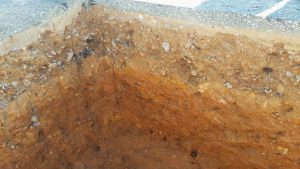
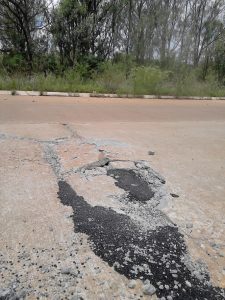
Cracked and Deformed Recycled Asphalt Pavement (Van Reenen’s Pass, 1985)Asphalt rutting-Poor Asphalt Mix-Unstable Mix due to poor design for expected traffic (N1, Bloemfontein)Thin asphalt Surfacing seal failure owing to crushing and weak interface – aggravated by waterCrocodile Cracking of old thin asphalt surfacing, aggravated by water and traffic loadingSecret of construction of a proper G1 Crushed stone layer- Slushing of the G1 Base to get excess fines out for proper consolidation and hence density of the layerThin asphalt (~30 mm) Rutting from Channelised and bi-directional HVS Traffic loading at elevated temperatures (>35 degree C)Asphalt Surfacing: Permanent Deformation-Channelised and bi-directional Traffic loading-Note tyre pattern imprint.Stress-In-Motion (SIM) measured tyre Vertical Contact Stress-7-Axle Vehicle on N3, Heidelberg, 2003/4. 26 tyres were measured. Note the un-equal contact patterns between tyres. Darker red, the higher the contact stress.High Temperature (>35 degree C) rutting test on BTB and asphalt surfacing-Wandering and bi-directional HVS Traffic (N2, South Coast)Test pit showing top G1 Base layer – Crushed Dolomite-typical grey colour. G1 on cementitious subbase layer.Single axle tyre footprints showing un-equal tyre loading. Note outer left tyre working extremely hard (very high contact stresses, compared to inner twin tyre, barely touching the road surface. Tyre will heat up, and eventually burst owing to over heating.Test pit of a BTB pavement with two cementitious subbase layers. Note the good quality of construction, (N3, near Durban, 1986/7)Fatigue Cracking of cementitious subbase layers under extreme HVS tyre loading – Wandering and bi-directional mode.Pumping under HVS tyre loading, wet crushed cementitious base layer pavement.. Base layer failed in crushing in the dry state. Wandering and bi-directional HVS loading mode.Cross Section-Bitumen Treated Base (BTB) and asphalt surfacing Pavement after HVS test. loading mode was wandering and bi-directional.HVS test showing Lateral water Erosion under the BTB layer from the stabilised Berea Red Sand subbase layers, pushing BTB upwards outside HVS test section. Water was added on the side of HVS test section and penetrated into the interface, causing erosion of the top of the cementitious subbase layer. Caution to be taken when stabilising Berea red Sand in wet areas.Stress-In-Motion (SIM) measured tyre Vertical Contact Stress-7-Axle Vehicle on N3, Heidelberg, 2003/4. 26 tyres were measured. Note the un-equal contact patterns between tyres. Darker red, the higher the contact stress. Note missing tyre on second last axle.., with inner tyre carrying the loading of twin tyres.In-situ Multi Depth Deflectometer (MDD) in cementitious base and subbase pavement in-situ, after HVS testing (Rooiwal, 1988/89)Longitudinal Crack with carbonation towards bottom of cementitious subbase layer in BTB and asphalt surfacing layer. Red areas showing good cementation (ph > 11) using the phenolphalien carbonation test. Note darker areas where water penetrated from the top through the crack into full pavement depth.Carbonation of upper cementitious subbase layer (not coloured), directly under BTB and asphalt surfacing – using the phenolphalien test. (Van Reenen’s Pass, 1985)Dry crushing failure in top cementitious base layer under extreme HVS tyre loading- Wandering and bi-directional loading mode.Pothole after wet HVS test on crushed cementitious base pavement (Rooiwal, 1988/7)Carbonation of upper cementitious subbase layer (not coloured), directly under BTB and asphalt surfacing – using the phenolphalien test. (Van Reenen’s Pass, 1985)Granular Base failure in shear mode – typical shear failure (Mohr-Coulomb)Poor maintenance (patching) and drainage on old pavement. Dangerous condition.Technology Transfer – very important for training.Stress-In-Motion (SIM) test Matrix: Vertical Contact Stress patterns of a single tyre under various tyre loading and tyre inflation pressures. Ideal case ~ 720 kPa, at 20 kN . This is indicative of overloading the tyre for a chosen inflation pressure.Crushed and weak interlayer causing failure of new asphalt sealRoad Surface Deflection with RSD device and 80 kN axle load test truck.Shear and crocodile cracking in both wheel paths.Un-equal Truck loading=Un-equal tyre loading. This is a typical safety and tyre overloading contact problem !Education is key..!!- Once a student, always a student..!Weigh-in-Motion (WIM) of vehicles on a National Road- Quantification of tyre and axle loading crucial for pavement design-1Weigh-in-Motion (WIM) of vehicles on a National Road- Quantification of tyre and axle loading crucial for pavement design-2Traffic associated cracking in thin concrete base layer using HVS in wandering and bi-directional loading mode.Multi deck Static Scale for trucks and heavy vehicles at a Weigh bridge on our National roads.Gautrans Heavy Vehicle Simulator (HVS) testing on Concrete Pavement. For more information on HVSs click link below:
Weigh-in-Motion (WIM) of vehicles on a National Road- Quantification of tyre and axle loading crucial for pavement design-3Gautrans HVS on concrete pavement with Joint-Activity-Meters (JAM)Complete failure into brittle state- pothole after 1st rainsFinal granular base layer before asphalt surfacing – let it dry to ~ 50% Optimum Moisture Content (OMC) before tack coat and surfacing.FAST_Falling Weight Deflectometer-FWD_1- For road surface deflection basin (or bowl)FAST_Falling Weight Deflectometer-FWD_2Two HVS MK III machines on Test Site at UC Davis Campus, CA, USACracked and sealed Concrete-Rigid-Pavement-CaliforniaHVS_MK VI-Mexico_2015HVS_MK VI-Mexico_2015 with test carriage and test axlesWirtgen Foamed-Bitumen_Paddle_Mixer-MexicoClose-up: HVS_MK VI-Mexico_2015 with test carriage and test axlesCSIR HVS MK III (Former Gautrans)Close-up: Test pit on road R25, Gauteng-1Test pit on road R25, Gauteng-2Traffic control during forensic road inspection test pitConcrete Weigh-in-Motion (WIM) – RIGID SUPPORT STRUCTURE CRITICAL FOR ACCUARTE AXLE LOAD READINGS.STATIC-TYRE-PRINT-ON-HOT-DAY-asphalt seal -DEFORMATIONTwo HVSs stored at GautransGautrans HVS MK_IV at GautransDual-Tyre-Static-Footprint using paint and HVS tyre LoadingPavement Design with DYNAMIC-CONE-PENETROMETER-DCP. Click link below for DCP low volume road design and associated free software.
Typical-Surfacing-Options-CAPSA-2015SIM-MK-VI-Proto Type demonstratorLight Weight Falling weight Deflectometer (LWD)Close-up: LIGHT-WEIGHT-DEFLECTOMETER-LWDASTM Standard 8kg-Dynamic Cone Penetrometer (DCP) (South African original, 60 degree cone tip)WIDE-BASE (WB) TYRE TESTING with HVS and SIM Pad deviceWIDE-BASE-WB-TYRE TESTING with HVS-Channelised TraffickingSIM_SURFACE-ROUGHNESS-80kN-SINGLE-TYRE-TESTCOMPRESSION FAILURE-THIN-CONCRETEPreparation for traffic counting loopsTypical Cross-Section of rubber pneumatic tyre (SABS1550)Effect of tyre inflation pressure under the same loading but different inflation pressuresClose-Up-single tyre extreme tyre loadingBW-SIM-TEST MATRIX-VERTICAL-CONTACT-STRESS of a single tyre at various loadings and tyre inflation pressuresBW-SIM-TEST MATRIX-LONGITUDINAL-CONTACT-STRESS of a single tyre at various loadings and tyre inflation pressuresBW-SIM-TEST MATRIX-LATERAL-CONTACT-STRESS of a single tyre at various loadings and tyre inflation pressuresStandard_40kN-Dual-Tyre-Vertical Contact StressStandard_40kN-Dual-Tyre-Lateral Contact StressStandard_40kN-Dual-Tyre-Longitudinal Contact StressWorkshops-Seminars_RMPD-Tech-Transfer_Fortaleza-Brazil-2016ZOAB ASPHALT SURFACING – URBAN ROAD-NETHERLANDSHVS MKV-COSTA-RICA-2016Tyre Stress-in-Motion (SIM)-MKVB Pad DeviceRMPD-JOURNAL-BOOKS-INTERNATIONAL-PEER REVIEWED PAPERS since 1999. Click link below for Journal by Taylor & Francis Online
DUAL PAD SIM SYSTEM MK VB at GautransTESTING ON SIM-SOLID-RUBBER-TYREMOUNTAIN PASS-SOUTH AFRICA-GORDONS-BAY-2017Crocodile Cracking in both wheel paths – old dry surfacing sealParking lot- CROCODILE-CRACKING-COLD-WEATHER, ALPS.CROCODILE-CRACKING-COLD-WEATHER-ALPSSTEEL DRUM COMPACTORSDUAL SIM PAD-MK-VBCrushing failure of very thin surface treatment on Stabilised base (HVS Testing)Test pit showing Phenolphthalein Test for carbonated Stabilised Layers. Red layer showing relatively good cementation. Base layer seems to be fully carbonated and therefore potential poor strength.Active cracking and pumping from stabilised base layerActive block racking and pumping from stabilised base layerPotholeEdge-BreakingPavement Rutting and Water-Skid Problem.4 x SIM PADs-Heidelberg SIM tests in 2003/4Test Truck moving towards SIM system-2003Close-up Truck towards SIM systemStress-in-Motion (SIM) system for Tyre-Road Pavement Interface contact stresses (Poster)Dual Tyres on SIM-Pads- Unequal Tyre loading owing to different tyre inflation pressures.Cracked surface Pumping fines from highly Stabilised Base layerWiggling Yellow Line-Asphalt deformation due to instability at high temperaturesShear failure in granular base layer-1Shear failure in granular base layer-2Pothole with water – danger !Grass growing in Pavement-Poor maintenanceFatigue cracking under HVS-Cemented Base, under extreme single loading-wandering modeStrongly Stabilised Base: Fatigue cracking on national road (1970’s)Heavy Vehicle Simulator (HVS_MK IV) testing on concrete pavementHeavy Vehicle Simulator (HVS_MK IV) testing on concrete pavement with JDMD apparatus for surface deflectionTwo HVS MK III machines at University of Davis, California, USA (HVSs exported from South Africa)Close-up of Test axle bogie of the ew HVS_MKVI delivered in Mexico-2015CSIR HVS_MKIII, originally from Gautrans (Old TPA).HVSs stored at GautransGautrans HVS_MKIVAsphalt rutting under channelised traffic with HVS showing tyre contact groovesClose-up: Asphalt rutting under channelised traffic with HVS showing tyre contact groovesNew HVS_MKVI in Costa Rica – 2016Fatigue cracking of cementitious base under aircraft loading with HVS wandering traffic.3-D Tyre contact testing on the Stress-In-Motion (SIM) Dual Pad deviceHVS loading on a wet test section: Tyre loading and water is cancer to any cracked pavement








 ROAD PAVEMENT FORENSIC ENGINEERING (RPFE)